Home
/
Blog
/
AI Recruiting
/
AI In Recruitment: The Good, The Bad, The Ugly

AI In Recruitment: The Good, The Bad, The Ugly

Author
Ruehie Jaiya Karri
Calendar Icon
July 5, 2023
Timer Icon
3 min read
Share

Explore this post with:

Artificial Intelligence (AI) has permeated virtually every industry, transforming operations and interactions. The tech recruitment sector is no exception, and AI’s influence shapes the hiring processes in revolutionary ways. From leveraging AI-powered chatbots for preliminary candidate screenings to deploying machine learning algorithms for efficient resume parsing, AI leaves an indelible mark on tech hiring practices.

Yet, amidst these promising advancements, we must acknowledge the other side of the coin: AI’s potential malpractices, including the likelihood of cheating on assessments, issues around data privacy, and the risk of bias against minority groups.

The dark side of AI in tech recruitment
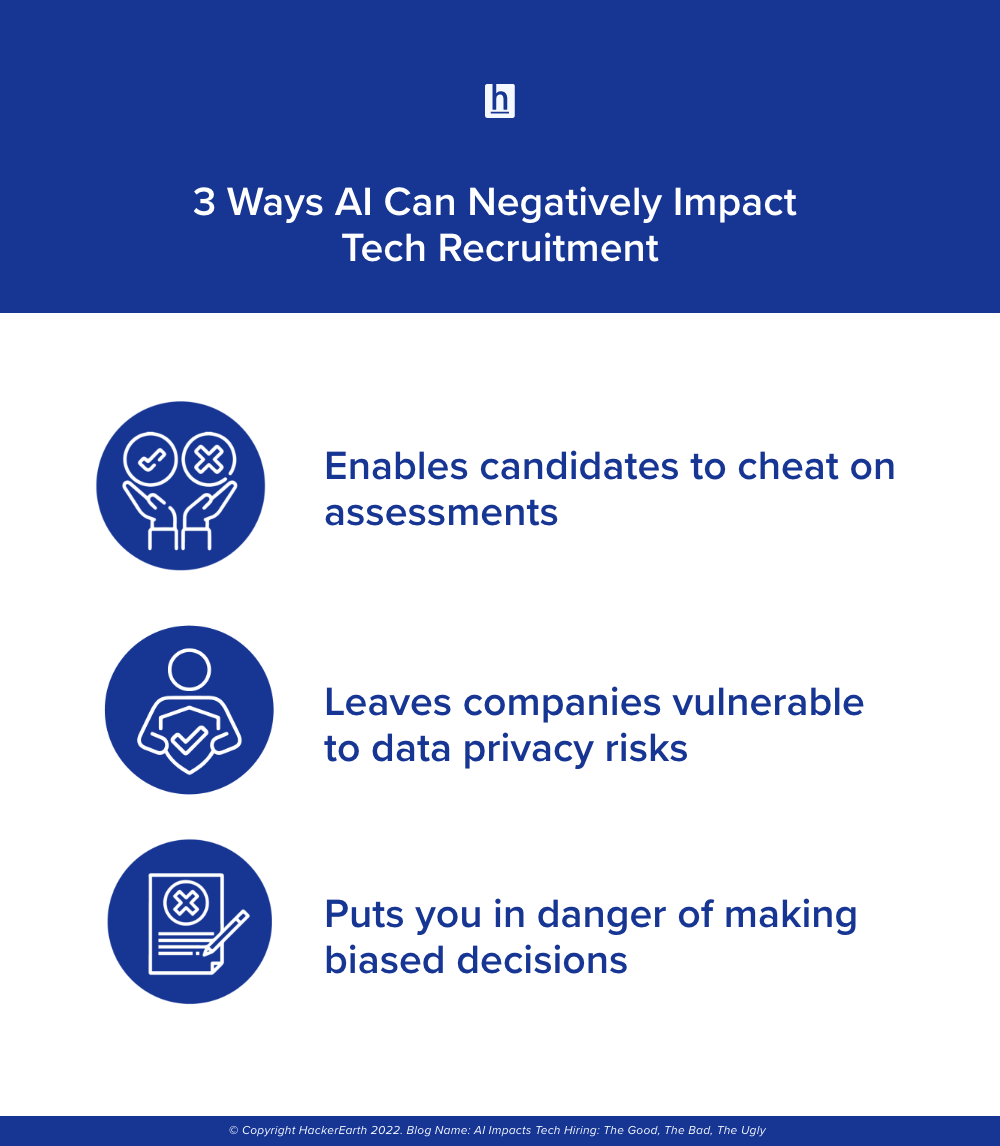
Negative impact of AI

The introduction of AI in recruitment, while presenting significant opportunities, also brings with it certain drawbacks and vulnerabilities. Sophisticated technologies could enable candidates to cheat on assessments, misrepresent abilities and potential hiring mistakes. This could lead to hiring candidates with falsifying skills or qualifications, which can cause a series of negative effects like:

  • Reduced work quality: The work output might be sub-par if a candidate doesn’t genuinely possess the abilities they claimed to have.
  • Team disruptions: Other team members may have to pick up the slack, leading to resentment and decreased morale.
  • Rehiring costs: You might have to let go of such hires, resulting in additional costs for replacement.

Data privacy is another critical concern

Your company could be left exposed to significant risks if your AI recruiting software is not robust enough to protect sensitive employee information. The implications for an organization with insufficient data security could be severe such as:

  • Reputational damage: Breaches of sensitive employee data can damage your company’s reputation, making it harder to attract clients and talented employees in the future.
  • Legal consequences: Depending on the jurisdiction, you could face legal penalties, including hefty fines, for failing to protect sensitive data adequately.
  • Loss of trust: A data breach could undermine employee trust in your organization, leading to decreased morale and productivity.
  • Financial costs: Besides potential legal penalties, companies could also face direct financial losses from a data breach, including the costs of investigation, recovery, and measures to prevent future breaches.
  • Operational disruption: Depending on the extent of the breach, normal business operations could be disrupted, causing additional financial losses and damage to the organization’s reputation.

Let’s talk about the potential for bias in AI recruiting software

Perhaps the most critical issue of all is the potential for unconscious bias. The potential for bias in AI recruiting software stems from the fact that these systems learn from the data they are trained on. If the training data contains biases – for example, if it reflects a history of preferentially hiring individuals of a certain age, gender, or ethnicity – the AI system can learn and replicate these biases.

Even with unbiased data, if the AI’s algorithms are not designed to account for bias, they can inadvertently create it. For instance, a hiring algorithm that prioritizes candidates with more years of experience may inadvertently discriminate against younger candidates or those who have taken career breaks, such as for child-rearing or health reasons.

This replication and possible amplification of human prejudices can result in discriminatory hiring practices. If your organization’s AI-enabled hiring system is found to be biased, you could face legal action, fines, and penalties. Diversity is proven to enhance creativity, problem-solving, and decision-making. In contrast, bias in hiring can lead to a homogenous workforce, so its absence would likely result in a less innovative and less competitive organization.

Also read: What We Learnt From Target’s Diversity And Inclusion Strategy

When used correctly, AI in recruitment can take your hiring to the next level

How to use AI during hiring freeze

How do you evaluate the appropriateness of using AI in hiring for your organization? Here are some strategies for navigating the AI revolution in HR. These steps include building support for AI adoption, identifying HR functions that can be integrated with AI, avoiding potential pitfalls of AI use in HR, collaborating with IT leaders, and so on.

Despite certain challenges, AI can significantly enhance tech recruitment processes when used effectively. AI-based recruitment tools can automate many manual recruiting tasks, such as resume screening and interview scheduling, freeing up time for recruiters to focus on more complex tasks. Furthermore, AI can improve the candidate’s experience by providing quick responses and personalized communications. The outcome is a more efficient, candidate-friendly process, which could lead to higher-quality hires.

Let’s look at several transformational possibilities chatbots can bring to human capital management for candidates and hiring teams. This includes automation and simplifying various tasks across domains such as recruiting, onboarding, core HR, absence management, benefits, performance management, and employee self-service resulting in the following:

For recruiters:

  • Improved efficiency and productivity: Chatbots can handle routine tasks like responding to common inquiries or arranging interviews. Thereby, providing you with more time to concentrate on tasks of strategic importance.
  • Enhanced candidate experience: With their ability to provide immediate responses, chatbots can make the application process more engaging and user-friendly.
  • Data and insights: Chatbots can collect and analyze data from your interactions with candidates. And provide valuable insights into candidate preferences and behavior.
  • Improved compliance: By consistently following predefined rules and guidelines, chatbots can help ensure that hiring processes are fair and compliant with relevant laws and regulations.
  • Cost saving: By automating routine tasks for recruiters, chatbots can help reduce the labor costs associated with hiring.

Also read: 5 Steps To Create A Remote-First Candidate Experience In Recruitment

How FaceCode Can Help Improve Your Candidate Experience | AI in recruitment

For candidates:

Additionally, candidates can leverage these AI-powered chatbots in a dialog flow manner to carry out various tasks. These tasks include the following:

  • Personalized greetings: By using a candidate’s name and other personal information, chatbots can create a friendly, personalized experience.
  • Job search: They can help candidates search for jobs based on specific criteria.
  • Create a candidate profile: These AI-powered chatbots can guide candidates through the process of creating a profile. Thus, making it easier for them to apply for jobs.
  • Upload resume: Chatbots can instruct candidates on uploading their resume, eliminating potential confusion.
  • Apply for a job: They can streamline the application process, making it easier and faster for candidates to apply for jobs.
  • Check application status: Chatbots can provide real-time updates on a candidate’s application status.
  • Schedule interviews: They can match candidate and interviewer availability to schedule interviews, simplifying the process.

For hiring managers:

These can also be utilized by your tech hiring teams for various purposes, such as:

  • Create requisition: Chatbots can guide hiring managers through the process of creating a job requisition.
  • Create offers: They can assist in generating job offers, ensuring all necessary information is included.
  • Access requisition and offers: Using chatbots can provide hiring managers with easy access to job requisitions and offers.
  • Check on onboarding tasks: Chatbots can help track onboarding tasks, ensuring nothing is missed.

Other AI recruiting technologies can also enhance the hiring process for candidates and hiring teams in the following ways:

For candidates:

  1. Tailor-made resumes and cover letters using generative AI: Generative AI can help candidates create custom resumes and cover letters, increasing their chances of standing out.
  2. Simplifying the application process: AI-powered recruiting tools can simplify the application process, allowing candidates to apply for jobs with just a few clicks.
  3. Provide similar job recommendations: AI can analyze candidates’ skills, experiences, and preferences to recommend similar jobs they might be interested in.

For recruiters:

  • Find the best candidate: AI algorithms can analyze large amounts of data to help you identify the candidates most likely to succeed in a given role.
  • Extract key skills from candidate job applications: Save a significant amount of time and effort by using AI-based recruiting software to quickly analyze job applications to identify key skills, thereby, speeding up the screening process.
  • Take feedback from rejected candidates & share similar job recommendations: AI can collect feedback from rejected candidates for you to improve future hiring processes and recommend other suitable roles to the candidate.

These enhancements not only streamline the hiring process but also improve the quality of hires, reduce hiring biases, and improve the experience for everyone involved. The use of AI in hiring can indeed take it to the next level.

Where is AI in recruitment headed?

AI can dramatically reshape the recruitment landscape with the following key advancements:

1. Blockchain-based background verification:

Blockchain technology, renowned for its secure, transparent, and immutable nature, can revolutionize background checks. This process which can take anywhere from between a day to several weeks today for a single recruiter to do can be completed within a few clicks resulting in:

  • Streamlined screening process: Blockchain can store, manage, and share candidates’ credentials and work histories. Thereby speeding up the verification and screening process. This approach eliminates the need for manual background checks. And leads to freeing up a good amount of time for you to focus on more important tasks.
  • Enhanced trust and transparency: With blockchain, candidates, and employers can trust the validity of the information shared due to the nature of the technology. The cryptographic protection of blockchain ensures the data is tamper-proof, and decentralization provides transparency.
  • Improved data accuracy and reliability: Since the blockchain ledger is immutable, it enhances the accuracy and reliability of the data stored. This can minimize the risks associated with false information on candidates’ resumes.
  • Faster onboarding: A swift and reliable verification process means candidates can be onboarded more quickly. Thereby, improving the candidate experience and reducing the time-to-hire.
  • Expanded talent pool: With blockchain, it’s easier and quicker to verify the credentials of candidates globally, thereby widening the potential talent pool.

2. Immersive experiences using virtual reality (VR):

VR can provide immersive experiences that enhance various aspects of the tech recruitment process:

  • Interactive job previews: VR can allow potential candidates to virtually “experience” a day i.e., life at your company. This provides a more accurate and engaging job preview than traditional job descriptions.
  • Virtual interviews and assessments: You can use VR to conduct virtual interviews or assessments. You can also evaluate candidates in a more interactive and immersive setting. This can be particularly useful for roles that require specific spatial or technical skills.
  • Virtual onboarding programs: New hires can take a virtual tour of the office, meet their colleagues, and get acquainted with their tasks, all before their first day. This can significantly enhance the onboarding experience and help new hires feel more prepared.
  • Immersive learning experiences: VR can provide realistic, immersive learning experiences for job-specific training or to enhance soft skills. These could be used during the recruitment process or for ongoing employee development.

Also read: 6 Strategies To Enhance Candidate Engagement In Tech Hiring (+ 3 Unique Examples)

AI + Recruiters: It’s all about the balance!

To summarize, AI in recruitment is a double-edged sword, carrying both promise and potential problems. The key lies in how recruiters use this technology, leveraging its benefits while vigilantly managing its risks. AI isn’t likely to replace recruiters or HR teams in the near future. Instead, you should leverage this tool to positively impact the entire hiring lifecycle.

With the right balance and careful management, AI can streamline hiring processes. It can create better candidate experiences, and ultimately lead to better recruitment decisions. Recruiters should continually experiment with and explore generative AI. To devise creative solutions, resulting in more successful hiring and the perfect fit for every open role.

Subscribe to The HackerEarth Blog

Get expert tips, hacks, and how-tos from the world of tech recruiting to stay on top of your hiring!

Author
Ruehie Jaiya Karri
Calendar Icon
July 5, 2023
Timer Icon
3 min read
Share

Hire top tech talent with our recruitment platform

Access Free Demo
Related reads

Discover more articles

Gain insights to optimize your developer recruitment process.

What It Takes to Keep Gen Z Engaged and Growing at Work

What It Takes to Keep Gen Z Engaged and Growing at Work

Engaging Gen Z employees is no longer an HR checkbox. It's a competitive advantage.

Companies that get this right aren’t just filling roles. They’re building future-ready teams, deepening loyalty, and winning the talent market before competitors even realize they’re losing it.

Why Gen Z is Rewriting the Rules

Gen Z didn’t just enter the workforce. They arrived with a different operating system.

  • They’ve grown up with instant access, real-time feedback, and limitless choice. When work feels slow, rigid, or disconnected, they don’t wait it out. They move on. Retention becomes a live problem, not a future one.
  • They expect technology to be intuitive and fast, communication to be direct and low-friction, and their employer to reflect values in daily action, not just annual reports.

The consequence: Outdated systems and poor employee experiences don’t just frustrate Gen Z. They accelerate attrition.

Millennials vs Gen Z: Similar Generation, Different Expectations

These two cohorts are often grouped together. They shouldn’t be.

The distinction matters because solutions designed for Millennials often fall flat for Gen Z. Understanding who you’re designing for is where effective engagement strategy begins.

Gen Z’s Relationship with Loyalty

Loyalty, for Gen Z, is earned, not assumed.

  • They challenge outdated processes and push for tech-enabled workflows.
  • They constantly evaluate whether their current role offers the growth, flexibility, and purpose they need. If it doesn’t, they start looking elsewhere.

Key insight: This isn’t disloyalty. It’s clarity about what they want. Organizations that align experiences with these expectations gain a competitive edge.

  • High turnover is the cost of ignoring this.
  • Stronger teams are the reward for getting it right.

What Actually Works

1. Rethink Workplace Technology

  • Outdated tools may be invisible to older employees, but Gen Z sees them immediately.
  • Modern HR tech and collaboration platforms improve efficiency and signal investment in people.
  • Invest in tools that reduce friction and enhance daily experience, not just track performance.

2. Flexibility with Clear Accountability

  • Gen Z values autonomy, but also needs clarity to thrive.
  • Hybrid and remote models work when paired with well-defined goals and explicit ownership.
  • Focus on outcomes, not hours. Autonomy with accountability is a combination Gen Z respects.

3. Continuous Feedback, Not Annual Reviews

  • Annual performance reviews feel outdated. Gen Z expects real-time feedback loops.
  • Frequent, actionable feedback helps employees improve faster and signals that their growth matters.
  • Make feedback a weekly habit, not a twice-yearly event.

4. Make Growth Visible

  • If career paths aren’t clear, Gen Z won’t wait. They’ll look elsewhere.
  • Internal mobility, structured learning paths, and reskilling opportunities signal future potential.
  • Invest in learning and development and make career trajectories explicit.

5. Build Real Belonging

  • Inclusion must show up in daily interactions, not just company values documents.
  • Inclusive environments where diverse perspectives are genuinely sought produce better decisions and stronger engagement.
  • Gen Z quickly notices when DEI is performative. Build it into everyday interactions.

6. Connect Work to Purpose

  • Gen Z wants to see how their work matters in a direct, traceable way.
  • Linking individual roles to tangible business outcomes increases ownership and engagement.
  • Purpose-driven work isn’t a perk. It’s a retention strategy.

7. Prioritize Well-Being

  • Burnout is a performance problem before it becomes attrition.
  • Mental health support, sustainable workloads, and genuine flexibility reduce stress and sustain engagement.
  • Policies must be real in practice. Gaps erode trust.

How to Attract Gen Z from the Start

Job Descriptions That Tell the Truth

  • Generic postings don’t convert Gen Z candidates. They want specifics: remote or hybrid expectations, real growth opportunities, and culture in practice.
  • Transparent job descriptions attract better-fit candidates and reduce early attrition.

Skills Over Experience

  • Gen Z and organizations hiring them increasingly value potential over tenure.
  • Skills-based hiring opens access to a broader, more diverse talent pool and builds teams equipped for change.
  • Hire for capability and future-readiness, not just years on a resume.

The Bottom Line

Retaining Gen Z isn’t about perks. It’s about rethinking the employee experience from the ground up.

  • Flexibility without accountability fails.
  • Purpose without visibility is hollow.
  • Growth that isn’t visible or structured drives attrition faster than most organizations realize.

The payoff: When organizations combine the right technology, real flexibility, continuous feedback, visible growth paths, and genuine inclusion:

  • Gen Z doesn’t just stay. They perform at a higher level.
  • Adaptive, future-forward thinking compounds over time.

That’s what separates organizations that thrive in today’s talent market from those constantly replacing people who left for somewhere better.

AI Tools for HR Managers in 2026: What's Actually Working (And What Isn't)

AI Tools for HR Managers in 2026: What's Actually Working (And What Isn't)

The current state of AI adoption in HR
88% of HR leaders say their organizations have not yet realized significant business value from AI. That number is striking, given that 91% of CHROs now rank AI as their single top priority. The gap is not a technology problem it is an adoption and strategy problem. Most HR teams have added AI to their workflows in some form, but very few have moved past experimentation into real, measurable impact.

This guide is for HR managers who want to change that. Not a list of tools to bookmark and forget, but a clear-eyed look at where AI is delivering results in 2026, what separates the tools that work from the ones that don't, and how to actually use them.

The adoption gap that most HR leaders aren't talking about

AI is present but underutilized.
According to the SHRM State of AI in HR 2026 report, 62% of organizations use AI somewhere in their business. But only 11% have embedded AI into daily workflows, defined as more than 60% of employees using it daily. That is a significant divide and explains why so many AI investments feel underwhelming.

Managers experiment more than employees.
A July 2025 Gartner survey of 2,986 employees found that 46% of managers are experimenting with AI, compared to just 26% of employees. Most organizations encourage exploration but fail to provide the structure, expectations, or training needed to make AI stick. Only 7% of organizations give employees guidance on how to use the time AI saves them.

The result: wasted potential.
Workforces have access to powerful tools but no framework for using them strategically. AI becomes another tab open in the browser, rather than a fundamental shift in how work gets done.

The opportunity is real.
Organizations that have moved from experimentation to integration are seeing tangible outcomes:

  • AI-powered recruitment tools reduce time-to-hire by an average of 30 days.
  • AI automates up to 60% of routine HR tasks, saving employees five or more hours per week.
  • Predictive analytics reduces voluntary turnover by 22–28% in the first year of deployment.

Capturing this opportunity requires the right tools and the right strategy.

Why 2026 is different from every other year of "AI in HR"

1. Skills-based hiring has gone mainstream.
Josh Bersin's 2026 Talent Report found that 72% of companies are moving away from degree requirements in favor of skills-based evaluation. Gartner reports that 65% of enterprises are actively prioritizing it. The traditional resume is no longer the most reliable signal of candidate quality, especially in tech roles where the half-life of skills is just two years.

2. Agentic AI has arrived.
Earlier generations of HR AI could automate tasks or analyze data. Agentic AI can plan, act, and iterate across entire workflows without constant human direction. 48% of large companies have already adopted agentic AI in HR, with projections showing 327% growth by 2027. This is no longer experimental.

3. Regulatory pressure is real.
The EU AI Act now classifies hiring AI as high-risk, making transparency and audit trails a legal requirement. Any AI tool influencing hiring decisions must be explainable. Black-box systems are a compliance liability.

What separates genuinely useful HR AI tools from the rest

They augment judgment rather than replace it.
Great HR AI tools make professionals better at their jobs. They surface the right information at the right moment, flag unnoticed patterns, and reduce cognitive load. Tools that try to remove humans entirely create legal risk and distrust. 88% of HR leaders haven’t seen ROI largely because their tools automate the wrong things.

They generate actionable insight, not just output.
Predictive models identify at-risk employees six months before they leave, skills-gap analyses shape hiring plans before a role opens, and candidate matching highlights transferable potential. This is the difference between AI that saves time and AI that changes decisions.

They are transparent and explainable.
Employees trust AI-generated reviews twice as often when they understand the criteria. 67% of candidates accept AI screening as long as a human makes the final call and the process is explained. Transparency builds trust, drives adoption, and ensures compliance.

Top AI tools for HR managers in 2026

HireVue
Standard for AI-powered video interviews and structured candidate assessments at scale. Cuts time-to-hire by 50%, supports 40+ languages, and uses IO psychologist-vetted guides. Bias audits and deterministic algorithms ensure fairness. Ideal for regulated industries and high-volume hiring.

Eightfold AI
Built for skills-first talent strategy. Maps 1.6 billion career profiles to a skills graph, matching candidates on potential rather than keywords. Increases recruiter productivity by 50%+ and reduces diversity sourcing time by 85%. Best for large enterprises focused on internal mobility and workforce planning.

Workday
Comprehensive HR platform with agentic AI for workforce planning, analytics, and employee lifecycle management. Acquisition of HiredScore integrates AI recruiting orchestration. Suitable for organizations needing a single system for headcount planning to performance reviews.

Lattice
Focuses on employee performance and engagement. AI identifies growth patterns, surfaces feedback trends, and flags disengagement early. Predictive models detect at-risk employees six months in advance, enabling targeted retention strategies. Ideal for culture and retention-focused organizations.

HackerEarth
Covers full tech hiring lifecycle, from sourcing developers through hackathons to live technical interviews. OnScreen AI interview agent uses lifelike avatars for structured, bias-free interviews. Ensures verification and cheat-proof processes. Trusted by Google, Amazon, Microsoft, Barclays, and Walmart.

Moving from experimentation to impact: a practical framework

1. Start with one high-friction problem.
Automate workflows that cost the most time or cause the most inconsistency typically initial candidate screening. Measure outcomes to justify next investments.

2. Define success before deployment.
47% of CHROs haven’t established clear AI productivity metrics. Set baseline and target improvements: time-to-shortlist, quality-of-hire, recruiter hours per hire anything trackable.

3. Put managers in the loop.
AI adoption gaps are often a manager problem. Give managers specific use cases, integrate AI into workflows, and provide language to discuss it with their teams.

The bottom line

AI will not change HR’s fundamental nature it remains a people function requiring judgment, empathy, and context. What AI improves is:

  • The quality of information available for every decision.
  • The time HR teams spend on work that doesn’t require judgment.

Organizations getting ahead in 2026 are those that select the right tools for the right problems and give teams structure to use them effectively. That is where the real advantage lies.

How to Handle Conflict at Work

How to Handle Conflict at Work

HR leaders often hear the same concern: "Small issues are turning into big problems, and teams are getting harder to manage."

They’re right. Conflict isn’t new, but how it appears today is different. Teams move faster, deadlines are tighter, and the pressure to deliver is constant. Friction builds quickly, and what used to stay small now escalates before anyone notices.

Here’s what most teams miss: the same conflict slowing them down can also be the thing that makes them stronger.

How Small Issues Turn Into Big Problems

You’ve probably seen this pattern before.

It starts with a misunderstanding, a missed expectation, or a poorly communicated decision. Nothing major, just enough tension to create distance.

That tension rarely gets addressed. Instead, it turns into silence. People stop raising concerns, avoid difficult conversations, and begin working around each other instead of with each other.

Over time, silence becomes disengagement. Collaboration drops. Trust weakens. Performance slips, and there’s no single moment you can point to as the cause. You’re left wondering, "What actually went wrong here?"

The shift that changes everything: the best teams don’t avoid conflict. They address it early. Honest communication and neutral guidance turn potential problems into opportunities to strengthen teams.

Conflict Is More Predictable Than It Feels

Most workplace conflict comes from a few common triggers:

  • Miscommunication or lack of clarity
  • Unclear roles and ownership gaps
  • Differences in work styles or expectations
  • Pressure from deadlines and performance targets

Recognizing these patterns early makes conflict easier to manage and often preventable.

Step 1: Make It Easy to Speak Up Early

The biggest reason conflict escalates is silence.

People notice issues early but hesitate to raise them. Maybe they don’t feel safe. Maybe they think it’s not worth it. By the time it surfaces, it always is.

The fix is straightforward:

  • Create regular space for honest conversations
  • Normalize feedback outside formal reviews
  • Train managers to handle uncomfortable discussions confidently

When people speak early, problems stay small and solvable.

Step 2: Act Early It Only Gets Harder

Many teams wait, hoping issues will resolve themselves. Conflict doesn’t disappear.

Small issues become frustration. Frustration becomes disengagement. Disengagement becomes attrition.

The best HR teams act early, even when conversations aren’t perfect. Early action is always easier than late correction.

Step 3: Managers Decide How Most Conflicts End

Strong HR processes matter, but most conflicts begin with managers.

Many managers aren’t equipped to handle conflict well. They avoid it, rush it, or escalate too quickly.

What works:

  • Listen before reacting. Understand what’s happening before seeking a resolution.
  • Stay neutral under pressure. Avoid taking sides prematurely.
  • Give clear, specific feedback. Vague conversations leave both sides confused.

When managers get this right, most conflicts resolve before HR intervention is needed.

Step 4: Focus on What Happened, Not Who Someone Is

It’s easy to say, "They’re difficult to work with."

It’s more effective to say, "Here’s what happened and the impact it had."

This shift:

  • Reduces defensiveness
  • Keeps conversations objective
  • Leads to faster, more durable outcomes

People can change behaviors. They resist being labeled.

Step 5: Give People a Process They Can Trust

Uncertainty worsens conflict.

Employees ask: Who do I go to? What happens next? Will this be handled fairly?

If answers aren’t clear, people stay silent or escalate too late. A simple, transparent process builds confidence and encourages early action.

How to implement:

  • Document it
  • Communicate it
  • Ensure managers know it as well as HR

Where Things Usually Go Wrong

Even strong HR teams fall into common traps:

  • Ignoring early warning signs — hoping small issues resolve themselves
  • Taking sides too quickly — before understanding the full picture
  • Relying on policy over people — process matters, but relationships matter more
  • Focusing on blame instead of outcomes — conflict resolution isn’t about who’s right

The goal isn’t to assign fault. It’s to decide what works next.

The Bottom Line

Conflict isn’t going away. How you handle it is a choice.

Handled poorly: drains teams and erodes culture.
Handled well: builds trust, sharpens communication, and strengthens performance faster than most team-building initiatives.

The best workplaces aren’t conflict-free.
They are just better at navigating it than everyone else.

Top Products

Explore HackerEarth’s top products for Hiring & Innovation

Discover powerful tools designed to streamline hiring, assess talent efficiently, and run seamless hackathons. Explore HackerEarth’s top products that help businesses innovate and grow.
Frame
Hackathons
Engage global developers through innovation
Arrow
Frame 2
Assessments
AI-driven advanced coding assessments
Arrow
Frame 3
FaceCode
Real-time code editor for effective coding interviews
Arrow
Frame 4
L & D
Tailored learning paths for continuous assessments
Arrow
Get A Free Demo